.
Similarly one may ask, what is echo in PowerShell?
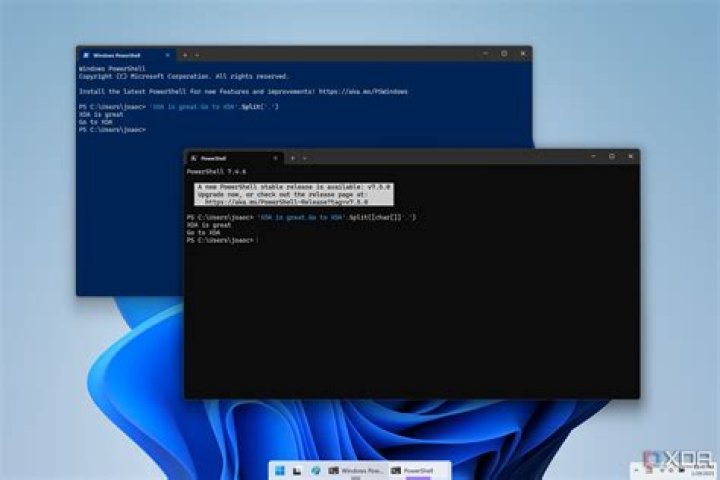
echo is alias to Write-Output although it looks the same as Write-Host. It isn't What is the difference between echo and Write-Host in PowerShell?. echo is an alias for Write-Output, which writes to the Success output stream. This allows output to be processed through pipelines or redirected into files.
One may also ask, how do you show variables in PowerShell? To view all environment variables in the current PowerShell session, you can run the command: Get-ChildItem Env: This is equivalent to running the Set command in Cmd.exe. returns The ALLUSERSPROFILE variable is C:ProgramData.
Subsequently, question is, what is used for in PowerShell?
PowerShell is the shell framework developed by Microsoft for administration tasks such as configuration management and automation of repetitive jobs. The term 'PowerShell' refers to both – the shell used to execute commands and the scripting language that goes along with the framework.
Do batch commands work in PowerShell?
PowerShell.exe can of course be called from any CMD window or batch file to launch PowerShell to a bare console like usual. You can also use it to run commands straight from a batch file, by including the -Command parameter and appropriate arguments. The way this is used to target our .
Related Question AnswersWhat is ECHO OFF command?
The ECHO-ON and ECHO-OFF commands are used to enable and disable the echoing, or displaying on the screen, of characters entered at the keyboard. The ECHO-OFF command suppresses echoing for the terminal attached to a specified process. The ECHO-ON command restores input echoing for a specified process.How do I stop a PowerShell script?
You can type the 'continue' debugger command at the prompt to let the script continue running. You can then type Ctrl+Break again if you want to once more break into the debugger. Or you can type the 'quit' debugger command to stop the script from running and be returned to your normal console prompt.What is echo in bash?
Bash Echo is a command in bash shell that writes its arguments to standard output. Whatever you see in the terminal is because of echo command being executed by other programs.What is the echo command in bash?
The echo Command. echo is a built-in command in the bash and C shells that writes its arguments to standard output. A shell is a program that provides the command line (i.e., the all-text display user interface) on Linux and other Unix-like operating systems.What is $# in Unix?
$# Stores the number of command-line arguments that were passed to the shell program. $? Stores the exit value of the last command that was executed. $0 Stores the first word of the entered command (the name of the shell program). So basically, $# is a number of arguments given when your script was executed.What is echo command in batch file?
Batch file : ECHO command. by Srini. When a batch file is being executed, if echo is turned on, it would print the command currently it's running on to the command prompt. By default echo is turned on for any batch file. We can turn off echo by including the following line in the beginning of the file.How do I get output in PowerShell?
By default, PowerShell sends its command output to the PowerShell console.Long description
- Use the Out-File cmdlet, which sends command output to a text file.
- Use the Tee-Object cmdlet, which sends command output to a text file and then sends it to the pipeline.
- Use the PowerShell redirection operators.
How do I write a PowerShell script?
How to create PowerShell script file on Windows 10- Open Start.
- Search for Notepad, and click the top result to open the app.
- Write a new, or paste your script, in the text file — for example:
- Click the File menu.
- Select the Save As option.
- Type a descriptive name for the script — for example, first_script.