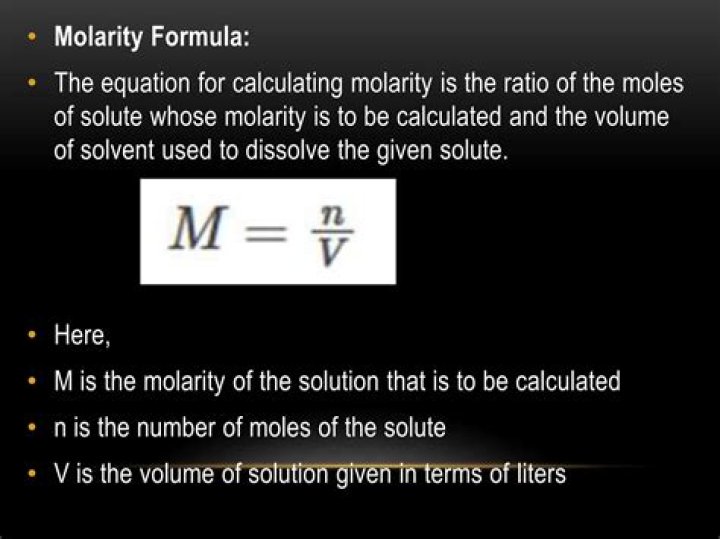
To calculate molarity:
- Find the number of moles of solute dissolved in solution,
- Find the volume of solution in liters, and.
- Divide moles solute by liters solution.
.
Herein, how do I find the molarity of a solution?
To calculate molarity, divide the number of moles of solute by the volume of the solution in liters. If you don't know the number of moles of solute but you know the mass, start by finding the molar mass of the solute, which is equal to all of the molar masses of each element in the solution added together.
Secondly, how do you find the concentration of an unknown solution? Divide the moles of solute by the volume of the solution in liters. Set up your equation so the molarity M = mol/V, where mol is the number of moles of the solute and V is the volume of the solvent. Solve the equation and label the answer M. In this example, M = (0.45 mol)/(0.4 L) = 1.125 M.
Additionally, how do you find the molarity of an unknown acid?
Use the titration formula. If the titrant and analyte have a 1:1 mole ratio, the formula is molarity (M) of the acid x volume (V) of the acid = molarity (M) of the base x volume (V) of the base. (Molarity is the concentration of a solution expressed as the number of moles of solute per litre of solution.)
How do you make a 1% solution?
The mass of a solute that is needed in order to make a 1% solution is 1% of the mass of pure water of the desired final volume. Examples of 100% solutions are 1000 grams in 1000 milliliters or 1 gram in 1 milliliter.
Related Question AnswersWhat is normality formula?
It is defined as the gram equivalent weight per liter of solution. Here, a more favorable calculation for normality is considered, where the normality of a solution is equal to the molarity multiplied by the number of equivalents. Normality(N) = Molarity(M) x number of equivalents. Normality Formula Questions: 1.How do you make a solution?
The following steps describe the procedure for making a solution of a specific molarity from a pure, solid substance.- First, weigh out the correct mass of solute.
- Dissolve the solute in water, keeping the volume less than the desired total volume of solution.
- Dilute the solution to the desired total volume of solution.
Is concentration the same as molarity?
Concentration is the ratio of the amount of solute per amount of solution. Molarity is a unit of concentration that specifically relates the number of moles of a solute per liter of solution.Can I titrate a solution of unknown concentration?
Titration is the slow addition of one solution of a known concentration (called a titrant) to a known volume of another solution of unknown concentration until the reaction reaches neutralization, which is often indicated by a color change.Is NaOH an acid or base?
NaOH is a base because when dissolved in water it dissociates into Na+ and OH- ions. It is the OH- (hydroxyl ion) which makes NaOH a base. In classical term a base is defined as a compound which reacts with an acid to form salt and water as depicted by the following equation. NaOH+HCl=NaCl+H2O.How many moles are in NaOH?
1 molesWhat is the molarity of HCl?
Dilutions to Make a 1 Molar Solution| Concentrated Reagents | Density | Molarity (M) |
|---|---|---|
| Ammonia 35% | 0.880 | 18.1 |
| Ammonia 25% | 0.910 | 13.4 |
| Hydrochloric acid 36% | 1.18 | 11.65 |
| Hydrochloric acid 32% | 1.16 | 10.2 |
How do you find molarity of HCl?
Ultimately, to find the maximum molarity of the HCl in water, we must use the concentration equation for molarity, which is defined as moles of the solute divided by the liters of the solution (M = moles of solute/ liters of solution).What is the concentration of the NaOH solution?
Your stock solution of Sodium Hydroxide is calculated to be 37.875 M based on a density of 1.515 g/mL, a formula weight of 40 g/mol, and a concentration of 100% w/w. To make a 1 M solution, slowly add 26.403 mL of your stock solution to 250 mL deionized water.How do you solve titrations?
Titration Problem Step-by-Step Solution- Step 1: Determine [OH-] Every mole of NaOH will have one mole of OH-.
- Step 2: Determine the number of moles of OH- Molarity = number of moles/volume.
- Step 3: Determine the number of moles of H+
- Step 4: Determine the concentration of HCl.
How do you find the concentration of NaOH in a titration?
Calculating a concentration- In a titration, 25.0 cm 3 of 0.100 mol/dm 3 sodium hydroxide solution is exactly neutralised by 20.00 cm 3 of a dilute solution of hydrochloric acid.
- Amount of solute in mol = concentration in mol/dm 3 × volume in dm 3
- The balanced equation is: NaOH(aq) + HCl(aq) → NaCl(aq) + H 2O(l)