.
In respect to this, how do you place a rugby ball on a kicking tee?
Steps
- Warm-Up.
- Place the ball on a tee.
- Step away from the ball preparing your run up.
- Focus your energy into your kicking leg.
- Begin your run up to the ball.
- Shift your weight onto your non-kicking foot, and allow your kicking leg to swing through striking the ball.
Likewise, how far is a conversion kick in rugby? After a team has scored a try (including a penalty try), they are awarded a "conversion" kick at goal. A successful kick is worth two points. The kick is taken from a point in line with where the ball was grounded for the try, as near or as far from the goal-line as the kicker desires.
Consequently, how long is a penalty kick in rugby?
The player must complete the kick within one minute even if the ball rolls over and has to be placed again. If the one minute is exceeded, the kick is disallowed, a scrum is ordered at the place of the mark and the opponents throw in the ball.
Can you steal the ball in rugby?
It's almost impossible to steal the ball if the tackler ends up under the tackled player. Give your players lots of live practice so they can recognise the situations where they can steal the ball. As soon as the ball carrier is brought to ground, the tackler has to get back on his feet.
Related Question AnswersCan you score a goal in rugby?
A team is awarded a goal kick after a try has been scored. The team has the chance to "convert" the kick at goal for two further points. The kick is taken from a point level with where the try was scored. The kick is successful if the ball goes between the opposition's goalposts and above the crossbar.Why do they punt in rugby?
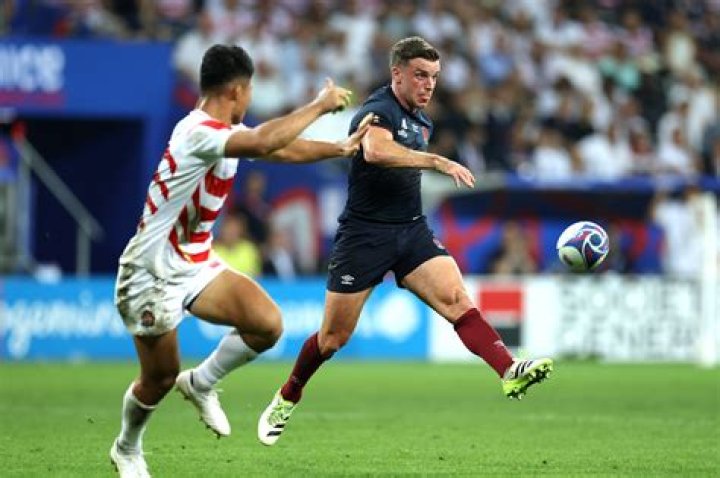
kicking into space, so that team mates have time to run onto the ball before an opponent can get to it. kicking out wide, at an oblique angle to the field, so that the wing or outside centre can catch the ball. kicking the ball to touch (off the field of play) resulting in a lineout with the throw-in to the opposition.What is a goal in rugby?
A goal can be scored from general play, from a penalty kick, or by converting a try. A rugby goal is shaped like the letter "H", and the goalposts are the two vertical lines. vertical posts connected by a crossbar. halfway line. To start a match, a player drop-kicks the ball from the middle of the halfway line.Can you kick the ball to yourself in rugby?
No. Law 12.1(f) says: “A player must not intentionally knock the ball forward with hand or arm, nor throw forward.” It doesn't matter if the player catches the ball again, as soon as it is intentionally thrown over the opponent's head, the offence has occurred.Are there downs in rugby?
There are no downs in rugby like there is in football. An offensive team may have the ball for 20 phases or downs in a row, if they can keep winning the ruck pile and push over the tackled player to win the ball and regain possession.How can I improve my kicking skills?
- The Kicking Foot. Make sure you are making contact with the ball with your instep rather than straight on over the laces.
- The Standing Foot. Your standing foot should not be behind or in front of the ball but just to the side of it.
- Consistent Approach.
- The Follow Through.
- Practice.
- Remain Calm.
What is the gain line in rugby?
The gain line, in rugby union, is an imaginary line (parallel to the halfway line) drawn across the pitch at the point where there is a breakdown in open play, such as a ruck, maul or scrum. Advancing across the gain line represents a gain in territory.What is the best rugby kicking tee?
Best Sellers in Kicking Tees- #1.
- Optimum Adjustable Kicking Tee, Blue, One Size.
- Rhino Club Kicking Tee.
- Centurion Deluxe Kicking Tee.
- Centurion Standard Kicking T.
- Gilbert Adjustable Kicking Tee.
- CENTURION PRECISION KICKING T.
- CreativeMinds UK Dan Carter Supertee Rugby Union/League Sports Ball Accessory Kicking Tee.