.
Hereof, what is the attached body form of cnidarians?
There are two basic cnidarian body shapes: a polyp form, which is attached to a surface; and an upside-down free-floating form called a medusa.
Likewise, how do cnidarians feed? Cnidarians are carnivores, and some can also consume plant matter. They catch their food using their nematocysts or through filter feeding. Cnidarians digest their food using a primitive digestive system that contains no organs--they have a mouth (which also serves as the anus) and a gastrovascular cavity.
Keeping this in consideration, what are examples of cnidarians?
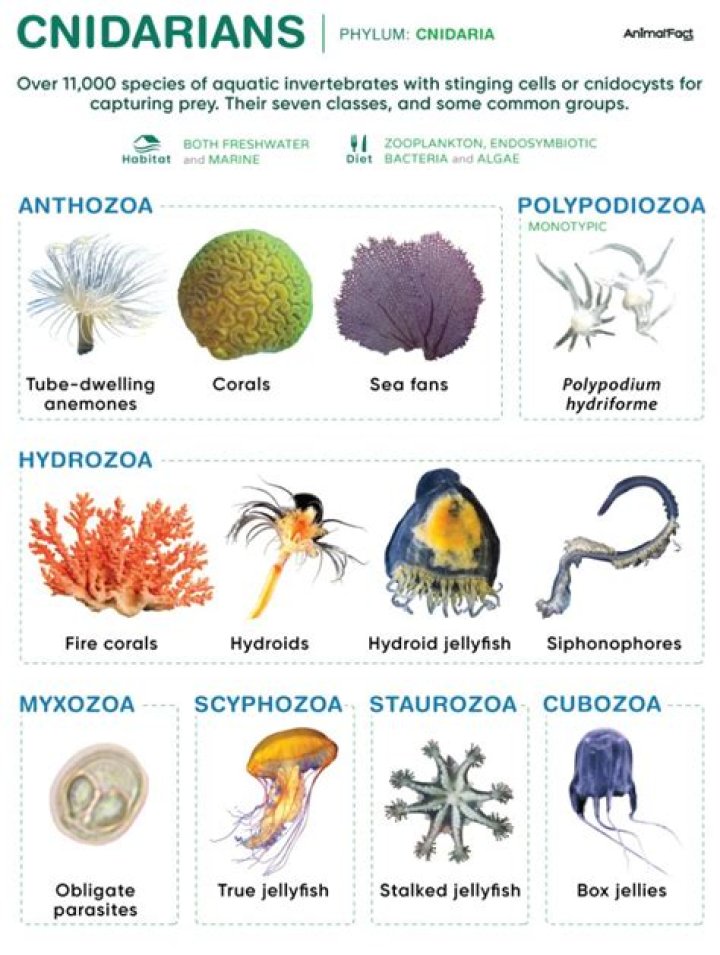
True jellyfishes Sea anemones and corals Sea anemone Box jellyfish Myxozoa
How do cnidarians grow and develop?
(D) The hydrozoan Clytia hemisphaerica forms a colony with feeding polyps (autozooids) and medusae-bearing gonozooids. Gametes are released from the medusae into the water. The embryo develops into a planula larva that settles to transform into a primary polyp, which then forms a new colony.
Related Question AnswersIs a sea anemone a polyp or a Medusa?
Unlike jellyfish, sea anemones do not have a medusa stage in their life cycle. A typical sea anemone is a single polyp attached to a hard surface by its base, but some species live in soft sediment and a few float near the surface of the water.What makes a jellyfish a cnidarian?
The Cnidarians include the hydroids, jellyfish, anemones, and corals. All Cnidarians use tentacles which have stinging cells which are used to subdue and capture food. The word "Cnidarian" means "stinging creature" in Latin (an old language that is still used in identifying animals).What is the difference between a Cnidocyte and Nematocyst?
Cnidocytes are also called cnidoblasts or nematocytes. Some cnidocytes can be found in the endoderm as well. The main difference between cnidocyte and nematocyst is that cnidocyte is a type of cell that helps predation of cnidarians whereas nematocyst is an organelle consisting of a coiled, thread-like stinger.What cells do cnidarians use for protection?
Cnidarians contain specialized cells known as cnidocytes (“stinging cells”), which contain organelles called nematocysts (stingers). These cells are present around the mouth and tentacles, serving to immobilize prey with toxins contained within the cells. Nematocysts contain coiled threads that may bear barbs.How do cnidarians defend themselves?
While some creatures such as sponges solve the dilemma of limited mobility by filtering the water for nutrients, cnidarians overcome the problem by deploying fast-acting neurotoxins through their stinging cells. These toxins can immobilize many prey and repel many predators upon contact.Do cnidarians reproduce sexually or asexually?
Reproduction of Cnidarians In general, polyps primarily reproduce asexually by budding, however, some produce gametes (eggs and sperm) and reproduce sexually. Medusae usually reproduce sexually using eggs and sperm.Do all cnidarians have nematocysts?
All Cnidarians have tentacles with stinging cells in their tips which are used to capture and subdue prey. In fact, the phylum name "Cnidarian" literally means "stinging creature." The stinging cells are called cnidocytes and contain a structure called a nematocyst. The nematocyst is a coiled thread-like stinger.Why are cnidarians considered simple but deadly?
Why are Cnidarians considered simple but deadly? They are simple bodied creatures but have deadly stingers that can cause serious pain to us, or in rare cases, death if the sting is severe.How do cnidarians get oxygen?
Cnidarians are aquatic animals that contain stinging cells called cnidocytes. While cnidarians do not have lungs or other respiratory organs, they do use body cells to take in oxygen and expel waste gases. This can be a problem in areas with stagnant water, as the lack of circulation decreases the available oxygen.What are five characteristics of cnidarians?
Terms in this set (5)- 5 main features of cnidarians. soft bodied, carnivorus, with stinging tentacles, body symmetry, and specialized tissue.
- 3 groups of cnidarians. jellyfish, hydras (and relatives), and sea anemones and coral.
- statocyst.
- ocelli.
- human activities that hurt coral.