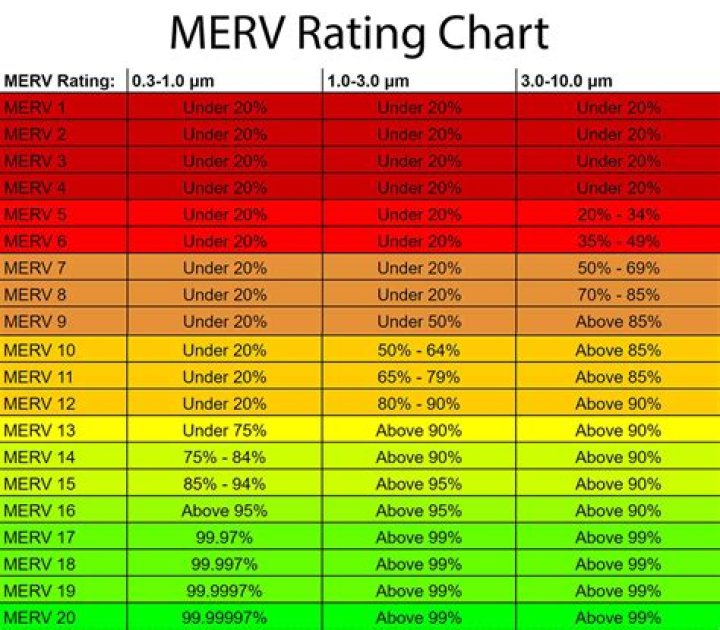
MERV means Minimum Efficiency Reporting Value which was developed by the American Society of Heating, Refrigeration and Air Conditioner Engineers - ASHRAE. MERV values vary from 1 to 16. The higher the MERV value is the value the more efficient the filter will be in trapping airborne particles.

.

Accordingly, is the higher the MERV rating better?

Higher Is Not Better The higher the MERV rating, the smaller the pores are for air to flow through an HVAC filter. This can create more resistance in airflow than a system is designed to manage, thus making it inefficient.

what MERV rating is best for home use? Better residential filters (5-8 MERV rating) will filter common household allergens such as dust, pollen, mold, and pet dander, while superior residential filters (9-12 MERV rating) will help to remove such things as cigarette smoke, which are more difficult to filter because they contain smaller particles.

Correspondingly, is MERV 13 too high?

When it comes to MERV ratings, there is such a thing as too high – depending on the type of HVAC equipment your customer has. Why? Because in order to receive a rating higher than 13, an air filter has to restrict the airflow so much that it can have a serious impact on HVAC system airflow.

Is MERV 8 good enough?

MERV 5–8 (good): These filters are better at catching small particles (3–10 microns) like mold spores, hair spray, dust mites and animal dander. MERV 13–16 (best): These filters are usually only found in hospitals because they can capture particles as small as 1–0.03 microns in size.

Related Question Answers

Does MERV 11 restrict airflow?

A decade ago, it used to be that if you had an HVAC system that used panel filters rated 6 through 9 MERV, putting in a MERV 11 or higher filter would restrict airflow (known as filter pressure drop). In turn, this would lengthen the system's run-time, adding to your heating and cooling costs.

What MERV rating is HEPA?

17-20

Is MERV 8 or 11 better?

Generally, the higher the MERV, the better the filter will perform at removing smaller particle sizes. MERV 1 through 4 are designed to remove large particles. At On Time Air Filters, we recommend Merv 8 filters as our "better" filter" and Merv 11 filters as our "best filter."

Is MERV 7 good enough?

For most residential systems, experts suggest using an air filter with a MERV value between 7 and 12. These filters offer adequate filtration and remove common contaminants such as pollen, mold spores, dust, pet dander, and tobacco smoke.

Is MERV 13 better than MERV 11?

MERV ratings will range from 1 (low efficiency; minimum filtration) to 20 (highest efficiency; highest filtration). For most household uses, the highest MERV rating used will be MERV 13 filters. For your home however, the better option is the FiltersFast MERV 11 air filters.

Do pleated air filters restrict airflow?

Because they restrict airflow to your HVAC system. Pleated, high-MERV filters definitely capture a lot of pollutants, but they also restrict the movement of air into your blower or furnace. These cover all the air filtration basics - dust and pollen removal, for example - without restricting airflow.

What Merv furnace filter should I buy?

The minimum efficiency reporting value (MERV) scale goes from 1 to 16. Most residential filters range from 4 to 12. Furnace manufacturers prefer the traditional spun fiberglass ac filters (MERV 2). These filter out enough of the large particles to protect the furnace while providing maximum airflow.

What is the best air filter for home?

So here is my list of The 10 Best Furnace Filters.
  • AIRx Health 1" MERV 13 Furnace Filters.
  • Honeywell FC100A1037 Ultra Efficiency 4" Furnace Filters.
  • Nordic Pure 4" Furnace Filters.
  • FilterBuy 1" Furnace Filters.
  • AIRx ALLERGY 1" Furnace Filters.
  • Filtrete Micro Allergen 4" Furnace Filters.
  • X6673 Lennox 4" Furnace Filters.

Can my furnace handle a MERV 13 filter?

MERV filters 1-4 are only good for blocking large particles from damaging your furnace. The ideal MERV filters for both air filtering and furnace efficiency are 7-13, experts say. These filters can be used without any modifications to your equipment. Your system may handle MERV 14-16 with no discernable stress.

Is MERV 11 too restrictive?

MERV 11 are approximately the same. A MERV 11 would be considered an “allergy” filter that does a good job of removing particles in all size ranges. Most of the thicker filters are sold as a MERV 11 or higher, but they are also available in a MERV 7 or MERV 8.

Will MERV 13 hurt my furnace?

Here's the problem: Some filters with a high MERV rating can drop air pressure in your duct system, which can increase energy bills and damage your HVAC system. For example, let's say you have a pleated filter that's 1-inch thick and has a 13 MERV rating.

What MERV rating can my furnace handle?

Higher rated filters allow less air to flow through though and can force your furnace to work harder and possibly malfunction. A MERV rating between eight and 11 is adequate for most homes. To be safe, you should check if your furnace manufacturer has a maximum MERV rating your model of furnace can use.

How often should you change a MERV 11 filter?

The MERV rating also determines generally how often to change your furnace filter. MERV 8 filters should be changed every 3-4 months, MERV 10 & 11 filters every 6 months and MERV 16 filters every year.

Which way does the airflow in my furnace?

If you are looking at a furnace filter, find the arrow that indicates the proper air flow direction. That arrow must always face toward the furnace and away from the return duct that carries the air in need of heating or cooling.

Will MERV 11 hurt my furnace?

Keep in mind that a MERV rating higher than 13 could negatively affect some HVAC systems, so it is advisable to verify that your unit can handle a higher rating before you make your purchase. According to Alex Hertzog, our in-house air filtration expert, MERV 11 filters are recommended.

Do I need filters in my return vents?

The Case for a Return Duct Filter Regular maintenance is certainly recommended, but adding a return air filter can help to block some of this incoming debris and ensure that the air coming in is clean. Clean air means a clean system.

How long do MERV 13 filters last?

Our MERV 13 filters trap 98% of airborne particles as small as .3 microns. Ideal for superior residential and commercial use and smoke lounges, this filter is designed to last 90 days.

Do I need a MERV 16 filter?

A MERV 16 filter is the most restrictive and will likely need to be changed every 3 to 6 months. Yes, they are more expensive than the average filter, but you get what you pay for. I change our MERV 13 filter every 4 months. We can get 6 months out of it, but we keep the fan “on” on our furnace.

How do I know what MERV filter to use?

The MERV scale is a standard measure of the ability of a filter to remove particles from your home's air. MERV ratings range from 1 to 20, with lower ratings denoting a lower-quality filter. MERV 1-4 Filters: Filters with a MERV rating of 1 to 4 do little to trap harmful particles in your home's air.