.
Similarly, it is asked, what is a nonspecific immune response?
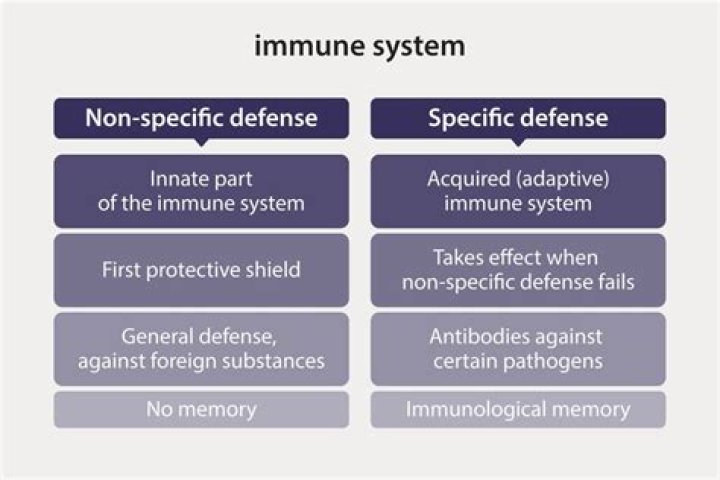
INNATE IMMUNITY. Innate, or nonspecific, immunity is the defense system with which you were born. It protects you against all antigens. Innate immunity involves barriers that keep harmful materials from entering your body. These barriers form the first line of defense in the immune response.
Additionally, what are 5 examples of nonspecific immunity? Examples of nonspecific defenses include physical barriers, protein defenses, cellular defenses, inflammation, and fever.
- Barriers. One way for an organism to defend itself against invasion is through barriers that separate the organism from its environment.
- Proteins.
- Cellular Defenses.
- Inflammation.
- Fever.
- Bibliography.
Likewise, people ask, what is the difference between a specific immune response and a non specific immune response?
nonspecific immunity are things that protect the body from various bacterias, viruses, and pathogens. Specific immunity are things that protect the body from specific pathogens. It includes the third line of defense. They include the lymphocytes (white blood cells) such as the macrophages, t cells, and memory b cells.
How does non specific immunity work?
The non-specific immune system involves defenses that are general and ongoing. Skin, parts of the lungs, and stomach are mechanical barriers. After the pathogen enters the body, non-specific cells like macrophages attack and ingest the pathogens, and natural killer T-cells attack the pathogen directly.
Related Question AnswersWhat are the steps of the immune response?
The normal immune response can be broken down into four main components:- pathogen recognition by cells of the innate immune system, with cytokine release, complement activation and phagocytosis of antigens.
- the innate immune system triggers an acute inflammatory response to contain the infection.
What does non specific mean in biology?
non-specific. 1. Not due to any single known cause, as to a particular pathogen. 2. Not directed against a particular agent, but rather having a general effect, as non-specific therapy.What are the main non specific defenses in the immune system?
Nonspecific defenses include anatomic barriers, inhibitors, phagocytosis, fever, inflammation, and IFN. Specific defenses include antibody and cell-mediated immunity.What is specific immune response?
Specific immune responses are triggered by antigens. The immune system responds to antigens by producing cells that directly attack the pathogen, or by producing special proteins called antibodies. Antibodies attach to an antigen and attract cells that will engulf and destroy the pathogen.Why is the innate immune system non specific?
The innate immune system is always general, or nonspecific, meaning anything that is identified as foreign or non-self is a target for the innate immune response. The innate immune system is activated by the presence of antigens and their chemical properties.What is the specific immune system?
The adaptive immune system, also known as the acquired immune system or, more rarely, as the specific immune system, is a subsystem of the overall immune system that is composed of highly specialized, systemic cells and processes that eliminate pathogens or prevent their growth.Why is phagocytosis non specific?
The process of phagocytosis, a type of nonspecific defense to disease. Phagocytosis is enhanced by products of the immune system called antibodies. These protein molecules bind to microorganisms and encourage engulfing by phagocytosis.What are nonspecific defenses?
Nonspecific defenses include physical and chemical barriers, the inflammatory response, and interferons. Physical barriers include the intact skin and mucous membranes. An example of such a substance is lysozyme, an enzyme present in tears that destroys the cell membranes of certain bacteria.What are the 5 parts of the immune system?
The main parts of the immune system are: white blood cells, antibodies, the complement system, the lymphatic system, the spleen, the thymus, and the bone marrow.What is an example of a specific defense?
It may be a toxin (injected into the blood by the sting of an insect, for example), a part of the protein coat of a virus, or a molecule unique to the plasma membranes of bacteria, protozoa, pollen, or other foreign cells. Once the foreign antigen is recognized, an agent is released that targets that specific antigen.What are the three important characteristics of the adaptive immune response?
Adaptive immunity is defined by two important characteristics: specificity and memory. Specificity refers to the adaptive immune system's ability to target specific pathogens, and memory refers to its ability to quickly respond to pathogens to which it has previously been exposed.What is a major characteristic of specific immunity?
Overview. One characteristic of specific immunity is recognition. The body does not usually start an immune response against its own antigens because cells that recognize self-antigens are deleted or inactivated. This concept is called self-tolerance and is a key characteristic that defines immune responses.How does the specific immune system work?
The main job of the innate immune system is to fight harmful substances and germs that enter the body, for instance through the skin or digestive system. The adaptive (specific) immune system makes antibodies and uses them to specifically fight certain germs that the body has previously come into contact with.What are the types of immunity?
There are three types of immunity in humans called innate, adaptive, and passive:- Innate immunity. We are all born with some level of immunity to invaders.
- Adaptive (acquired) immunity. This protect from pathogens develops as we go through life.
- Passive immunity.
- Immunizations.